


THE CAUSAL IMPACTS OF HUMAN MIGRATION AND COVID-19
Major Gheorghe Giurgiu1, Prof Dr Med Manole Cojocaru2, SciRes I, EuSpLM
1Deniplant-Aide Sante Medical Center, Biomedicine, Bucharest, Romania
deniplant@gmail.com; Telephone: +40744827881
https://orcid.org/0000-0002-5449-2712
2Academy Romanian of Scientists
Titu Maiorescu University, Faculty of Medicine, Bucharest, Romania
cojocaru.manole@gmail.com; Telephone: +40723326663
https://orcid.org/0000-0002-7192-7490
There is a growing literature that studies and attempts to estimate the impact of a pandemic on air pollution.
A new class of corona virus, known as SARS-CoV-2 (severe acute coronary respiratory syndrome 2) has been shown to be responsible for the onset of this disease.
Migration is the movement of people from one permanent home to another.
International migration is the movement from one country to another.
As International students are a very heterogeneous group, the effects on their health are also varied.
International students – may be both more affected by and vulnerable to the spread of COVID-19, they also play an important role in the response to COVID-19.
International students have also been affected by mobility restrictions in both their countries of origin and their countries of destination.
COVID-19 restrictions have an impact on the mobility of migrants and their role as humanitarian organizations
To discuss data on migrants that may inform how they are potentially affected by COVID-19 syndrome and are part of the pandemic response, todiscuss data on migrants that can inform how they are potentially both affected by the impact of COVID-19 syndrome and are part of the response to the pandemic.
We examined the relationship between human migration and air pollution and further evaluated the causal impacts of the lockdowns.
Another peer-reviewed analysis of national data sets shows that migrants from high-income countries are at increased risk of COVID-19syndrome
Interventional studies aimed at addressing/correcting these perturbations, either through dietary modification, pro/pre-biotic supplementation, or fecal transplantation, may lead to improved outcomes for patients with COVID-19.
However, all studies included in this review focused on migrants, displaced persons who are at higher risk of becoming infected due to their life and work.
This comunication reviews current knowledge relating to Deniplant nutriceuticals and its management in COVID-19.
Nutraceuticals refer to compounds or materials that can function as nutrition and exert a potential therapeutic effect, may lead to improved outcomes for patients with COVID-19 infection.
Treatments help with symptoms and may modify the disease outcome, especially early in the disease course.
The multidisciplinary management of these patients, including nutritional intervention, helps improve gastrointestinal symptoms, and avoid malnutrition, morbidity and improve quality of life.
Our experiments found that oral consumption of Deniplant nutraceuticals improves the clinical symptoms in patients with COVID-19 infection.
Natural products can modulate the inflammatory and/or oxidative mediators, regulate the production or function of the immune cells, thereby attenuating the experimental and clinical manifestation of the disease.
Nutraceuticals can be considered an adjunct treatment for COVID-19 to improve the quality of life of patients suffering from this disease.
Appropriate use of these adjunct therapies with antiviral proprieties may be beneficial in the treatment and/or prophylaxis of COVID-19 syndrome
The objective was to demonstrate role of Imuniplant in the management of disfunctional immune responses in COVID-19 syndrome.
The direct modulation of gut microbiome that could diminish inflammatory responses and ameliorate adaptive immune responses.
Here are some natural remedies that have helpedin the treatment of COVID-19syndrome.
– Imuniplant tea
–antiviral tea
–wormwood tea
–balneological plants
–inhalations and gargle with baking soda and salt
–propolis, honey, royal jelly
–diet without meat, vegetable soups, compotes, fruits and green vegetables
– onions, garlic, beets, black radish.
Recent reports indicate that dysbiosis is increased in COVID-19 syndrome.
Imuniplant modulation of the immune system has applications within the clinical setting, but can also have a role in the COVID-19 syndrome, acting to reduce manifestations.
Ongoing research in this field will ultimately lead to a better understanding of the role of diet and Imuniplant in immune function in COVID-19 syndrome
A dysfunctional immune system can cause a whole range of pro-inflammatory conditions like impaired gut function, weakened responses to infection.
Imuniplant may restore the composition of the gut microbiome and introduce beneficial functions to gut microbial communities, resulting in amelioration or prevention of gut inflammation and other disease manifestations.
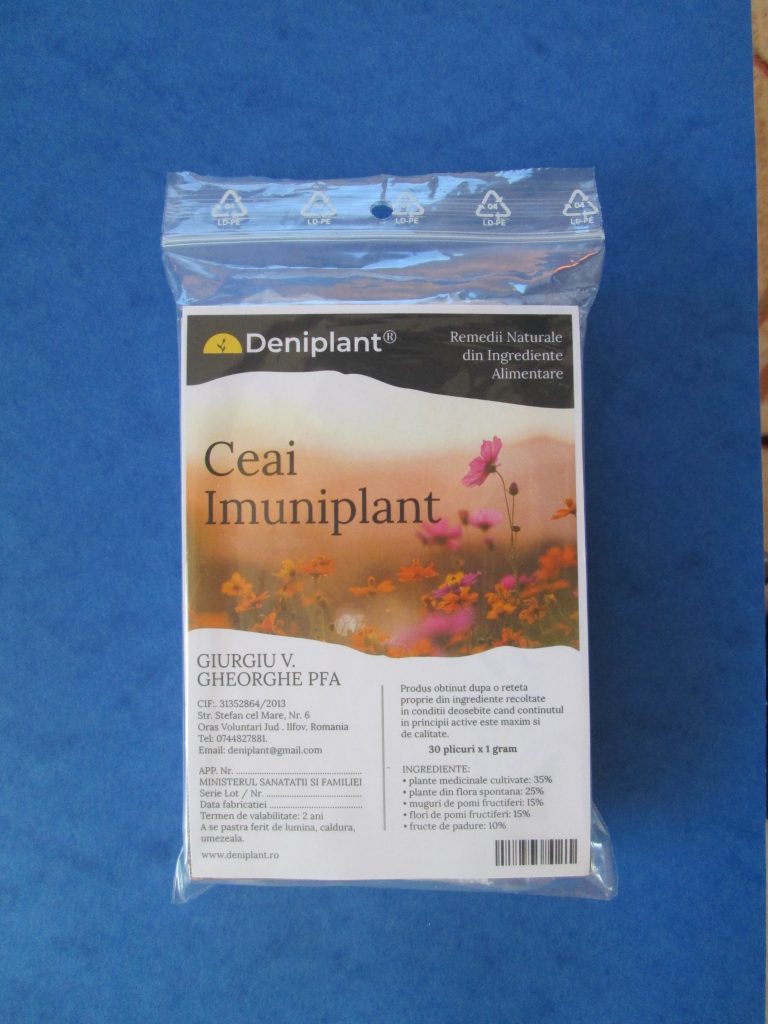

Imuniplant tea is a natural genetic immunomodulator of the human microbiome
Imuniplant tea is a natural genetic immunomodulator of the human microbiome that contributes to the removal of microbiota dysbiosis and thus the COVID-19 syndrome.
It contains:cultivated medicinal plants=35%; plant from the spontaneous flora=25%; buds of fruit trees=15%; flowers of fruit trees=15%; berries=10%
Form of presentation: dry and ground powder packed in tea bags of 1 geach. 30 envelopes/pack
Properties: it regulates cellular metabolism, it regulates the central nervous system, it modulates the activity of important neurotransmitters; physically and mentally energizing; remineralizing; it increases resistance to fatigue, natural modulator of the intestinal microbiome
Administration:740ml of tea that is drunk daily
Duration of treatment:
In relation to the evolution of the disease (2-6 months)
Contraindications:
There are not.
Side effects:
They did not appear after long-term use.
Terms of validity:
2 years from the date on the prospectus;
it is kept in the dark and at a constant temperature
Other specifications:
It can be used in parallel with the allopathic medication established by the attending physician
The COVID-19 pandemic has changed human mobility for those of us washing our hands vigorously and avoiding social contact.
As international students are a very heterogeneous group, the effects on their health are also varied.
Human migration patterns have subsequently been radically altered and many regions have seen perceived improvements in air quality during the lockdowns.
Nutraceuticals, such as a variety of phytochemicals from medicinal plants and dietary supplements, have been used as adjunct therapies for many disease conditions, including viral infections.
Conclusion
The composition of the gut microbiota changes with COVID-19 syndrome. The gut microbiota is considered to be a master regulator of immune homeostasis. Besides modifying the gut microbiota, Imuniplant modulates the immune system in COVID-19 syndrome.
Probiotics have been widely reported to act on the immune system.They are living microorganisms with immunomodulatory effects that stimulate Th1 cytokines and suppress the Th2 response, which are being researched for the treatment of COVID-19 syndrome.
Probiotics most commonly used are part of the intestinal microbiota like lactobacilli, bifidobacteria, and enterococci
References
Zeng J, Bao R. The impacts of human migration and city lockdowns on specific air pollutants during the COVID-19 outbreak: A spatial perspective. J Environ Manage. 2021; 282:111907.
Gope S, Dawn S, Das SS.Effect of COVID-19 pandemic on air quality: a study based on Air Quality Index.Environ Sci Pollut Res Int. 2021;28(27):35564-583.
Anastassopoulou CZ, Patrinos GP, Tsakris A Human genetic factors associated with susceptibility to SARS-CoV-2 infection and COVID-19 disease severity. HumanGenomics.2020; 14:
Subedi L, Tchen S, Prasad Gaire B, el al. Adjunctive Nutraceutical Therapies for COVID-19. Int J Mol Sci. 2021;22(4):1963
Moscatelli F, Sessa F, Valenzano A, et al. COVID-19: Role of Nutrition and Supplementation. Nutrients.2021; 13(3): 976.
Butler MJ, Barrientos RM. The impact of nutrition on COVID-19 susceptibility and long-term consequences. Brain Behav. Immun.2020;87:53–54.
Fernández-Quintela A, Milton-Laskibar I, Trepiana J, et al. Key Aspects in Nutritional Management of COVID-19 Patients. J. Clin. Med. 2020;9:2589. Childs CE, Calder PC, Miles EA. Diet and immune function. Nutrients. 2019;11:1933.

Author: Giurgiu Gheorghe
2023 Lansare magazin online 2022 Participare conferinte si congrese 2021 deniplant.com 2020 deniplant.eu 2020 Emisiunea Meloterapia si Meloterapia altfel 2020 Imuniplant Cito Remediu natural Anti HPV Oncogen 2019 Infiintarea Centrului de Biomedicina Deniplant- Aide Sante 2018 Grup de sprijin pentru persoanele paralizate. 2018 Neuromodulator al microbiomului. 2018 Artropol pentru afectiunile articulatiilor 2017 Imunomodulator natural al microbiomunui. 2016 Neuropolen - Regenerator natural al celulei nervoase. Remediu natural ce lupta cu paralizia 2015 Infiintarea Centrului de Wellness -Spa Biobreaza 2014 Polenoderm- Pentru o piele curata fara cosuri sau furunculi pe cale naturala . 2014 Sforamin produs nou pentru inlaturarea sforaitului pe cale naturala 2013 Polenoplasmin, pentru tratarea paraliziei la animale. 2012 Antistres Ceai de plante medicinale pentru combaterea efectelor cauzate de stres. 2011 Alergiplant Ceai de plante medicinale pentru alergii. 2010 Stoc caderii parului Plante pentru tinctura. 2010 Imuniplant Ceai de plante medicinale pentru afectiuni autoimune. 2009 Ceai Post operator pentru recuperarea rapida dupa interventii chirurgicale. 2009 Fructimet Ceai dun fructe de padure pentru afectiuni metabolice. 2009 Deniplant a devenit Marca Comunitara Europeana , fiind inregistrata la OHIM detalii.. 2008 Compania Deniplant JA a castigsat cu Deniplant Kids premiul I competitia Company of the Year 2008 organizat de Junior Achievement Romania si...